The Case of the Mysteriously Missing iBooks

Every now and then, I tidy up the media libraries on my mobile devices. When I sorted through the documents in the iBooks app recently, I noticed that two books — Aaron Cordova’s edition of The United States Constitution and the Little Snitch 3 documentation — appeared on the iPad, but not on the iPhone.

It took a friendly reminder from fellow-UX designer, Phil Suessenguth, to make me check whether these two titles were iPad-only.

Unfortunately, Apple makes that check surprisingly difficult.

A hint on the iPad — if you can find it

For starters, I searched for “little snitch” in iBooks on the iPad. It came up as the sole search result.
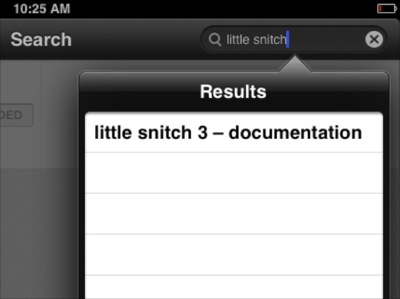
iBooks finds one matching title for my search term, and lists it in the Results menu.

When I tapped it, the book’s overview appeared. Because it was installed on the iPad, its status was properly displayed as “Downloaded”. This view does not indicate the book’s iPad-only status, though. For that, you need to dig a bit deeper.
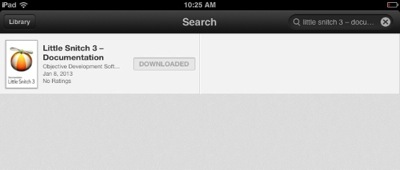
Now, the search shows the book's cover, title, author, release date, and ratings, but it does not state that this book is iPad-only.

After tapping the item, and scrolling down the Details section, I finally found a Requirements field. It is in this field that Apple tells you that this book is only compatible with the iPad.
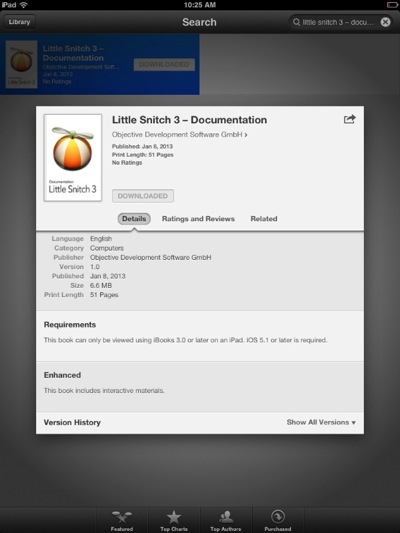
Only the Requirements section in the iBook Store's Details view clearly state that 'This book can only be viewed using iBooks 3.0 or later on an iPad.'

On the iPhone, the user experience is much worse.

“I ain’t telling you nuthin’!”

Performing the same search on the iPhone, iBooks did find the book again. My expectation with search results like this is that if you tap on any of them, you will be taken to the respective product’s details.
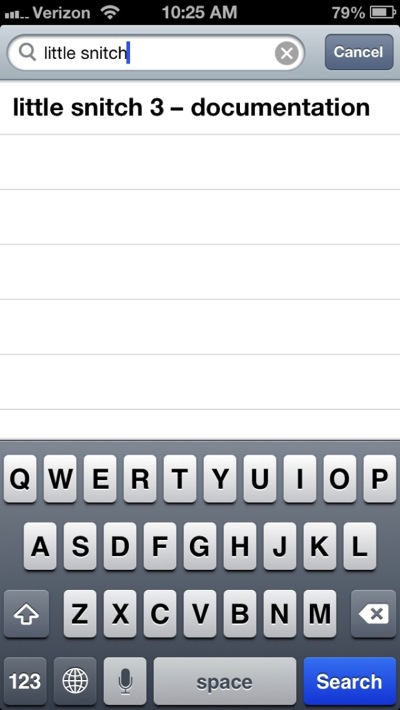
On the iPhone, the title appears in the search results list as well.

Not so in this case: Tapping the single search result brought up a blank screen, even though the app clearly found the exact title I was looking for.
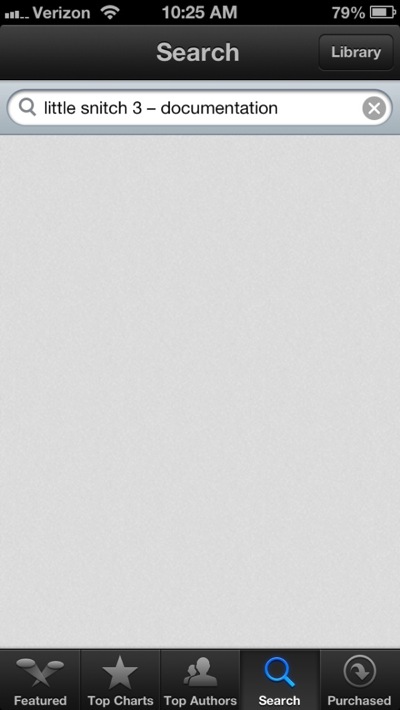
While the search field does show the exact title of the book I was searching for, the results view beneath it is completely blank.

At first, I thought I had run into a bug. So I terminated iBooks, relaunched it, repeated the search, and got the same result.

Worse yet, while the two books appear in the iTunes library on my Mac as well as in the Purchased Items list on the iPad, they are completely missing from that list on the iPhone. In fact, based on what you get to see on the iPhone, it’s as if I had never purchased the books at all, and I never could.

A hidden hint in iTunes

In the iTunes desktop application, you can see a book’s requirements when you view it in the Store.
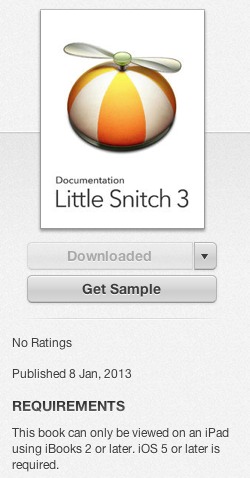
This detail view shows the Requirements section with the iPad-only notice, as it is displayed underneath the book's cover shot in the iTunes desktop app.

That changes as soon as you have downloaded the book: When you view it in the Books section of your iTunes library, there is no hint about a book’s iPad-only status. The Info dialog box on the book doesn’t help either, as the Kind field simply states “Purchased Book”, which applies to any book downloaded from the iBooks Store.

There is one place in the iTunes application, after all, where the compatibility information is displayed even for downloaded books: it’s the dialog box that opens when you double-click a book in iTunes.
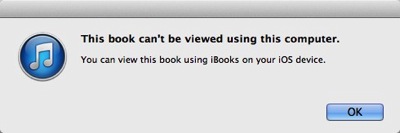
The warning dialog box states that 'This book can't be viewed using this computer. You can view this book using iBooks on your iOS device.'

Note how the ending of the second sentence changes if the book is iPad-only. Instead of “your iOS device”, it now says “your iPad”:
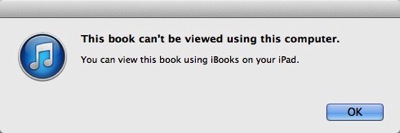
At first sight, this dialog box looks identical to the previous one. Its second sentence, however, ends in 'using iBooks _on your iPad_.'

This hint is so subtle, however, that I doubt it will be easily discoverable when you’re specifically looking for this piece of information.

Tell me what’s going on!!

If you missed the Requirements section when purchasing a book, or if you simply forgot about a specific book being iPad-only, the entire iTunes/iOS/iBooks infrastructure will leave you guessing why some books are synchronized to some, but not all, of your iOS devices.

Fixing this problem is easy:

  • In iTunes, an icon in the Books or List views could indicate the iPad-only status. The “kind” field could say “Purchased book (iPad only)”.

  • In iBooks, an icon could indicate iPad-only books, similar to how the “+” icon in the App Store indicates universal iOS apps that work on both iPhone and iPad.

  • On an iPhone, iPad-only books could appear in the Purchased Books list with their download buttons disabled and labeled “iPad only”. The same design approach could be used in the Store’s Search results list.

I find it baffling that this specific information is not provided in more prominent, more easily discoverable ways.
Instant Airline Reward Miles Credit

Claiming missing airline reward miles was covered in four previous articles on this website now, but here’s a twist to that process that makes me revisit this topic one more time.

The first article in the series dates back to August 2010 and compared the workflows for claiming uncredited airline reward miles between Lufthansa’s Miles & More program and British Airways’ Executive Club.1

At the time, I did put in a claim for uncredited miles with Lufthansa, but did not have any similar request for British Airways. Thanks to my parents being on British Airways flights before signing up for BA’s loyalty program, I finally did get to test the entire process with an actual mileage claim.

Method A: “Type a lot, wait a couple of weeks, and then we’ll see what happens.”

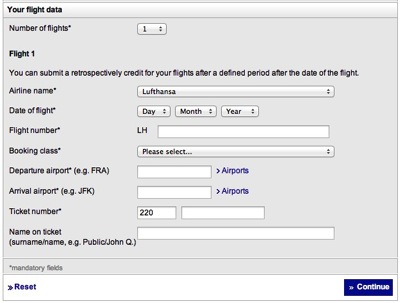
As a quick reminder, here’s the online form that Lufthansa requires you to fill out for claiming yet-uncredited reward miles:

The Miles & More reward miles claim form has eight fields for entering data like airline name, date of flight, etc. Of these eight fields, no less than seven are mandatory.

It is safe to assume that, like any other airline, Lufthansa keeps old booking records. With the ticket number serving as a unique identifier, why then are you required to fill in seven fields?

Method B: “Enter one number. Done!”

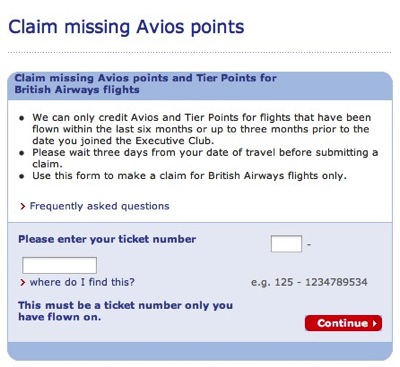
British Airways’ form requests that you enter exactly one data item which is, of course, the ticket number.

The British Airways form for claiming missing reward miles requires you to enter just the ticket number. Oddly though, this needs to be slit into two fields, one of which holds the first three digits, and the other holds the remaining ones.

When I tried this last time with a ticket number whose associated flights had already credited to my account, the website listed the respective flights’ miles as having been “[c]laimed previously through British Airways.”

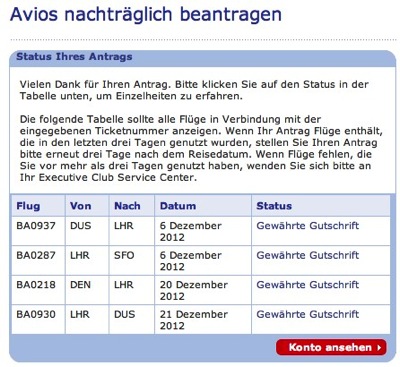
My parents’ newly created accounts had a mileage balance of exactly zero when I brought up the claim form this time. Entering a ticket number brought up a table of flights that was similar to the one I had seen previously.

After you enter the ticket number, and click Continue, the BA website will look up the flights that are linked to the number, and display them in a table.

The status, however, was now given as “Gewährte Gutschrift”: “Credit Granted”.

Clicking the “Konto ansehen” (“View Account”) button took me back to the account’s main page, and the balance now showed a non-zero amount.

Not only was it enough to enter just the ticket number; the respective reward miles were credited immediately without any wait time!

The possible impact of claiming miles from a partner airline

The mileage credit I had requested from Miles & More had been for a partner airline, and not for a flight with Lufthansa themselves. This may explain why it took a few weeks to see those miles added to my account.

It does not explain, however, why Lufthansa generally insists that you enter multiple redundant data items, whereas British Airways impressively demonstrates that this process works just fine if all you have is the ticket number.

Yet Another Attempt at Claiming Missing Airline Reward Miles

Back in August 2010 I had tested how you can claim missing airline reward miles via the websites of Lufthansa and British Airways, respectively. Just recently I was on two flights with United airlines, for which I still need to claim my reward miles. This made for the perfect opportunity for a follow-up on this topic.

Alas, in the almost one-and-a-half years since, almost nothing has changed.

The same-old, same-old (both good and bad)

British Airways rebranded their miles to “Avios”, so the wording of the link for claiming un-credited miles may just be that little bit less intuitive now. It is still in the same convenient location, though.

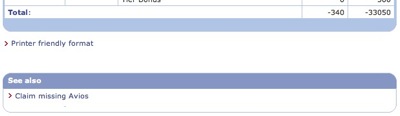
On the British Airways website, a link labeled 'claim missing avios' is located directly underneath the list of recent account transactions.

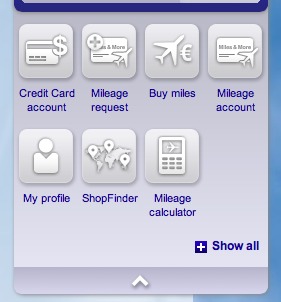
On Lufthansa’s Miles & More website, the previous text-only navigation menu has been replaced with a set of icons that mimic the look-and-feel of the iPhone’s Launchpad. In that menu, the “Request Miles” link/icon combo is a bit easier to find.

The Lufthansa Miles and More website displays a main navigation menu that consists of a number of icons with labels, one of which shows a loyalty card with a plane symbol and a plus sign, and labeled 'mileage request'.

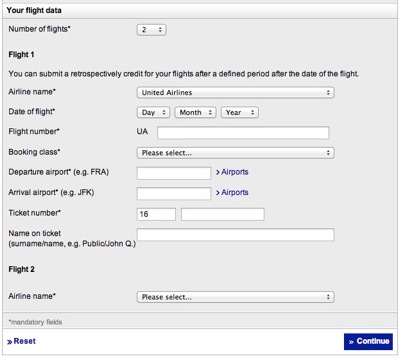
Unfortunately, my key complaint still applies: Where British Airways is happy to ask for just the ticket number to get the claim process started, Lufthansa still requires you to fill out this extensive form:

The form on the Lufthansa website contains eight data items, namely airline name, date of flight, flight number, booking class, departure airport, arrival airport, ticket number, and name on ticket. Of these, only the latter field is optional. All seven others are required.

Obviously, such minor changes alone would not justify writing about this topic again. The serious new problems I experienced with the Miles and More website now are well worth sharing with you, though.

Unknown #1: The flight class

The form requires picking a booking class. That information is not found on the boarding pass, but according to the confirmation email, the classes for my two flights were “G” and “K”, respectively.

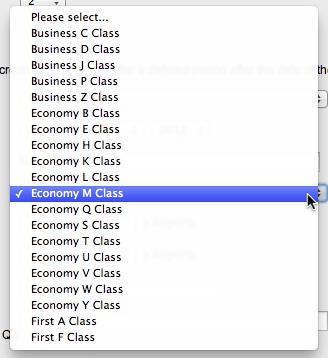
Surprisingly, the popup menu does not offer the former at all:

The booking class menu contains five items for business class, thirteen for economy, and two for first, but none of these are of type G.

Since the second flight was listed as a “K” class, I simply selected that class for the first flight as well.

Unknown #2: The flight number

On the boarding pass, the flight number is stated as “UA1555Y”. Nevertheless, the Miles & More website considers this number invalid:

The error message reads, 'Error with flight 2: Please enter a valid flight number'. The flight number field with the offending Y character is highlighted.

Admittedly, this problem is not directly linked to the website’s design. In fact, the error message is displayed prominently, and thanks to the high-contrast highlighting, it’s easy to find the field whose entry needs fixing. Also, in the confirmation email, the flight number is listed without the trailing “Y”.

Nevertheless, this is something that the website could take care of automatically: it could silently discard the offending character, or at least offer via a dialog box to fix this, saying something like: “The flight number ‘UA1555Y’ you have entered is invalid. Did you mean ‘UA1555’?”.

In this instance, it was easy to correct “my” mistake, but the biggest problem was yet to come.

Unknown #3: The airline code (Say what?!)

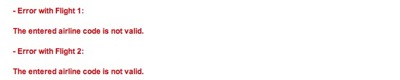
After hitting return, the form came back with the following error messages:

For both flights, an error message is displayed, reading 'The entered airline code is invalid'.

None of the form fields was highlighted, so it was impossible to tell which data item needed to be modified to make the website accept my input.

The only thing I could think of was to add the airline code to the flight number. Unfortunately, entering “UA268” instead of “268” did not help, as the site now complained about an invalid flight number.

If you think about it, the ticket number should be perfectly sufficient to verify a mileage claim. This is especially true if the ticket was purchased directly from a partner airline’s website.

Instead, you have to meticulously and manually copy a whole bunch of data from the boarding passes into the form. And once you did, you may very well be confronted with an error that you, as the user, cannot fix, but that stubbornly prevents you from submitting said data.

So I’m stuck now. And used the only option I had.

I’ve contacted Lufthansa via their website’s contact form and hope they will tell me what to do next. Who knows: Maybe they will even take the time to explain the problem to me.

As soon as I hear back from them, I’ll update this post. Stay tuned!