On the Subtle Differences Between Closed and Locked Doors

As part of a regular health check, I went to the hospital for a scheduled blood test this morning. Surprisingly, when I arrived, the lab was closed. Or so it seemed to me.

The door to the lab reception room was shut, and a sign mounted next to it stated that if the lab reception was closed, one should press the button on the adjacent intercom panel to get help.

I went ahead and pushed that button, heard a ringing tone through the intercom’s speaker, and waited; and waited; and waited some more. Until I heard that tremendously annoying sound of someone picking up at the other end, and immediately hanging up again. I found that rather peculiar and quite confusing.

I knew I was in the right place, because the sign above the door clearly stated “Laboratory.” I also knew I was there at the right time, because I had an appointment, whose time and date I had double-checked.

So I pushed that button again; heard the ringing tone again; and waited again. And then, just to be sure, I decided to give the door a gentle push to see whether it was actually locked, or just closed.1 I wish I could have seen the expression on my face when the door swung open without much effort.

What had gone wrong here?

One detail I have not mentioned yet, is that the door had one of those round knobs that (usually) cannot be rotated, and a safety door lock. My mental model of such a type of door — at least until today — says that if the door is closed, it is also locked, and that to unlock it, you must have the matching key. Which is a pretty accurate mental model, unless the specific door’s lock catch mechanism can be set to an “unlocked” position.

Consequently, just seeing this specific door made me assume that it was actually locked, and it did not occur to me to even try pushing it open.

I feel that the explanation on the sign further reinforced my assumption, because it emphasized that, at times, that door is, in fact, locked. To fix this, I’d suggest adding a single sentence to the instructions panel: instead of “If the lab reception is closed…” it should say “Please push the door open and enter without waiting for you to be called. If the lab reception is closed…”.

The difference is this: the first quote can be interpreted as “If the door appears to be closed/locked…”, whereas the second is closer to “Do check whether the door is open/unlocked. If not…”.

Ironically, the very moment that I left the lab through that door, another patient walked right in. What a shame that I could not observe them arriving at the door alone, so that they would not have seen the door being opened. It would have been interesting to see if they would have made the same “mistake” that I had made.


  1. The German word that was used in the instructions on the sign was “geschlossen”, which, colloquially, means both “closed” and “locked”. A more more precise word for the latter would be “abgeschlossen”. 

Printer Documentation in All the Right Places

Setting up a new desktop printer is easy: remove the printer from its box, insert ink or toner cartridges, plug in the power cord, connect it with the computer, and select the printer driver. That’s straight-forward enough that some users may choose to skip reading the installation manual altogether. Depending on the model, however, there may be some setup details that need special attention. Pointing these out to the user is as easy as putting the required documentation in the right places.

What color is your ink?

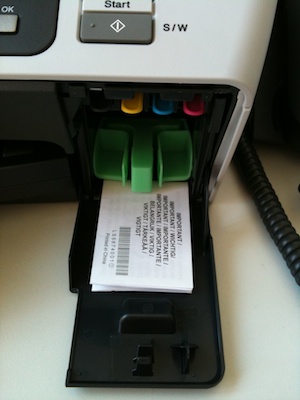
A printer model I set up recently, ships with a set of “special ink cartridges [included] inside this box for use during the initial setup process.” I don’t know how these cartridges differ from “normal” models in terms of technical details, but the printer is supposed to be operated with these cartridges first.

To ensure that even users who choose not to read the installation manual, are made aware of this requirement, the manufacturer has placed a little note right inside the ink compartment: open the compartment, and you cannot not discover this information.

Besides explaining about the special type of ink, the note also points out where to find the cartridges inside the printer’s shipping box.

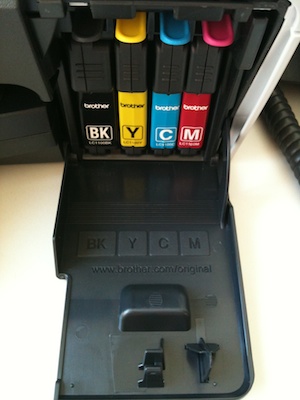
The ink cartridges themselves feature both colored labels and big letters for identifying their contents. The printer’s cartridge release tabs are died in plastic matching the color on the cartridge label, and the letters identifying the colors are molded onto the inside of the ink compartment’s door. Right below the letters is a URL pointing to the page about printer supplies on the manufacturer’s website.

I was a bit surprised that — with the exception of the black cartridge being slightly wider than the other three — these helpful and non-ambiguous visual cues were not complemented by any mechanical lockout feature to prevent the user from inserting a cartridge in the wrong slot.2

Don’t hook me up just yet!

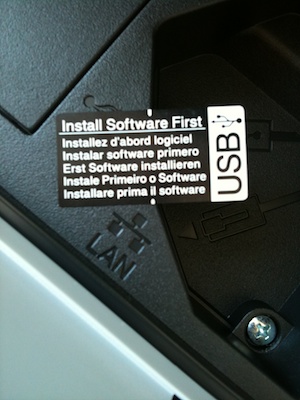
Usually, the driver software that ships with a hardware device must be installed before plugging in the USB cable between computer and device.3 To ensure that the user follows this order of steps during the installation, this particular printer features a small sticker tab placed right above the USB socket.

When trying to hook up the printer, the user cannot help but notice the sticker and its “Install software first” reminder. Once she’s found and (hopefully) read it, the sticker peels off easily, providing unobstructed access to the USB socket.


  1. This assertion is based on a visual inspection of the three color cartridges only, as I did not attempt to insert one into the wrong slot for fear of somehow screwing up the printing system. 

  2. This seems to be a problem specifically with machines running Microsoft Windows: on several occasions I somehow managed to have Windows assign the wrong driver to a newly-connected hardware device. In every single case, “convincing” Windows to un-assign this driver and accept a new one for the device in question, was a royal pain. 

Practicing Math Before Doing the Laundry

There are quite a few things in life that are more fun than doing the laundry. Why, then, do makers of laundry care products add some extra complexity to this task by confronting their customers with unnecessarily complicated dosage instructions?

Do your math

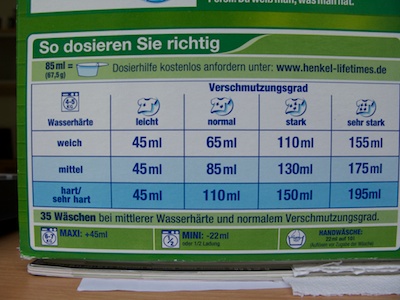
This table on a box of washing powder states how much powder should be used for one full load of laundry, based on water hardness (rows) and on how stained the clothes are (columns).

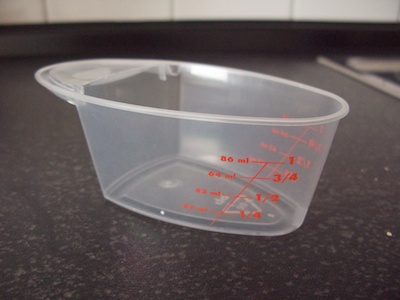
As a convenience to their customers, the manufacturer offers a free measuring cup, which holds about 85 ml of detergent. This cup has a precise scale printed on its side which is labeled with both milliliters and fractions.

Determining how many cups of detergent you need is a simple, straight-forward calculation, of course: divide the amount found in the table by the size of the cup. And yet, I would not be surprised if the majority of customers find such math to be inconvenient. To some, it may even be overtaxing.

Simply stating the amount of detergent in multiples and/or fractions of the measurement cup would eliminate the conversation calculation, making measuring decidedly simpler and faster.

Like powder, like liquid

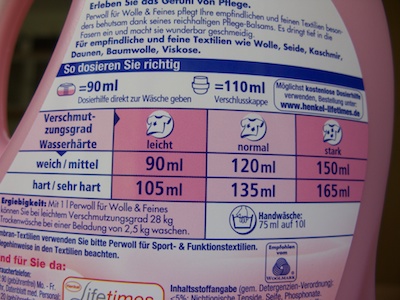
This bottle of liquid detergent features a measuring table similar to the one from the previous example. In this case, it is the bottle’s cap that serves as the measuring device, holding 110 ml.

Just like the table on the box of powder, this product also requires the user to convert milliliters into multiples and/or fractions of the measurement cap. Unlike the cup to be used with the powder, however, this cap does not feature a scale, making the measurement even more difficult.

Using the cap for measuring 165 ml — 1.5 caps — may still be feasible. But what about 120 ml or 135 ml?

As easy as one third, two thirds, three thirds

Compare the previous two designs to this one, which I found on a bottle of fabric conditioner.

In addition to listing precise amounts in milliliters (for soft, extra-soft, and hand-wash applications), this product also states fractions of the bottle cap (“Kappe”).4

The inside of that cap features fine lines molded into the plastic at 1/3 and 2/3 cap-fulls. Admittedly, these lines are a bit hard to see, but the designers did at least think of this feature to begin with.

Using the right amount of this product is as easy as comparing the levels indicated on the cap with what is stated on the bottle, and filling the cap to the required level.


  1. I don’t know whether there is a legal requirement to state the exact volume this way. Then again, who knows how many nitpicking customers would call the manufacturer’s hotline to ask for this information if it were not printed on the bottle…