Hidden Dairy, Hidden Handle, Hidden Thermostat

While I hope to finally be done with writing about claiming missing airline reward miles, another travel-related area should provide many more interesting things to share with you: Staying at a hotel.

Here are three new observations from that realm.

What’s in that fridge?

Whether you’re staying at a budget motel or pick luxury accommodation, breakfast is almost always served as a buffet. At swankier places, fruit, dairy, cold cuts, etc. are presented on elegant porcelain plates, seated on piles of crushed ice to keep the products fresh.

Less luxurious hotels usually serve pre-packaged, (more or less) brand-name-quality items that you will find at any supermarket. Instead of the more elegant “iced buffet” setup, more perishable products are simply stored in a fridge.

The challenge for the restaurant management, then, is to make it easy for their guests to find the breakfast delights they are looking for.

The straight-forward solution is a fridge with a glass door.
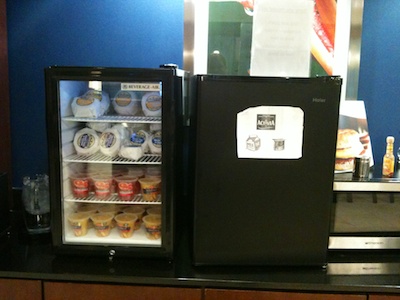
Two refridgerators side by side in a hotel breakfast buffet. One has a glass door, which lets you see what's inside without having to open its door.

You can instantly see what’s inside that fridge. Before you open the door, you can conveniently make selection, which also benefits the environment as it preserves energy.

The second-best approach is to list the fridge’s contents on its door. Best intentions of the restaurant staff notwithstanding, I found the 90s style clip-art-sporting label on this fridge a bit lacking in design prowess, but also in terms if information architecture.
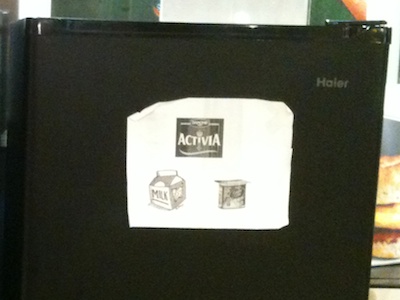
A sheet of paper is affixed to the fridge with the opaque door, showing the Activia brand symbol, a generic milk carton sketch, and an Activia yoghurt cup. All in glorious gray-and-white, and rather fuzzy at the edges.

The Activia logo at the top is only meaningful to someone who knows that brand, as is the somewhat obscure Activia-branded yoghurt cup on the right. The milk carton is more easily understood, but the “perspectivized” word “Milk” is difficult to read, especially from a distance, and especially for older eyes.

My guess is that simply placing the words “Milk & Yoghurt” in large type on that fridge would be much easier to understand for the average guest.

How (the heck!) do you open this thing?

The much more painful challenge that almost every guest had with both fridges, though, was actually opening them. Here’s a shot from a somewhat different perspective.
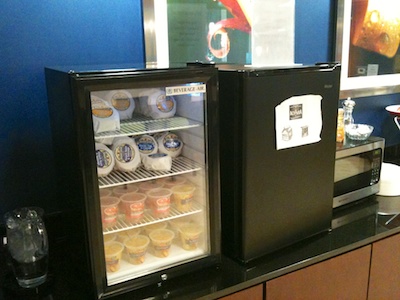
While you can see -- and feel -- the hinge brackets that hold both fridges' doors in place, there is no handle on either door.

See how both fridges lack an easily distinguishable handle?

Almost every person I observed was running their hands along the edges of the door to find a way to grasp it. The solution to this usability riddle is a groove that runs along the top of the door, and which you can grab — kind-a, sort-a — with the tips of your fingers.

Even after people had found that groove, they still struggled with predicting towards which side the door would open. Although the hinge brackets are visible, guests did not seem to notice them. No wonder, since the hinges’ black paint “nicely” blends in with the rest of the enclosure.

How expensive would it have been for the manufacturer to add a plain, simple, and highly visible handle to the fridges’ doors?

The position of such a handle would unmistakably indicate where and in which direction to pull, and on what side the door opens. They would also make it easier to get a good grasp on the doors, especially for older users or those with limited mobility in their fingers.

One set of controls for show, another for functionality

Moving from the breakfast buffet area into our room, this hotel features the typical, all-American, wedged-underneath-the-window air conditioning device. If you’ve ever stayed at a hotel with this kind of cooler/heater combo, you know that they can be ridiculously noisy. This specific unit was no exception.

Thankfully, its control panel is in plain sight right on the unit, and the controls themselves are simple enough to quickly spot the colder/warmer buttons, as well as the main power switch.1
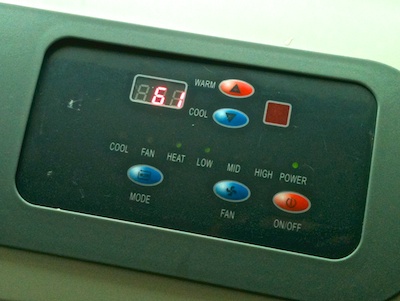
The design of the control panel on the A/C unit is simple enough that it's easy to find the buttons for setting the temperature, or for switching the unit off completely.

To my dismay, however, I kept pressing the buttons, but nothing happened.

My assumption was that, for some reason, guests were not allowed to change the machine’s setting. It’s that thing about “to the user, the UI is the system”. I.e., if the user interface does not seem to work, something in the system is either broken, or I’m not allowed to operate it or modify its configuration.

My assumption was wrong.

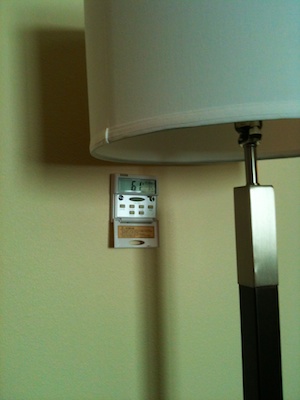
The next morning, after a somewhat sleepless night, we noticed a second control panel mounted to the wall opposite from the window, all the way across the room. You can see it in this photo, if you look very closely: It’s that minute silvery-white rectangle just below the floor lamp’s screen.
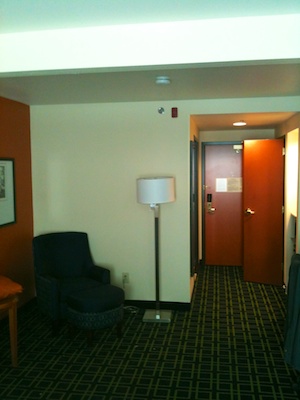
A tall floor lamp's screen at the other end of the room blocks the view of the thermostat mounted to the wall.

Here’s a better view:

The old-fashioned wall thermostat, ironically, has a less user-friendly user interface than the non-functional controls on the A/C unit.

It took just a few button presses to verify that this control panel worked just fine.

To whomever designed that Activia-branded dairy label for the fridge: Can you please print out a sheet that says “Adjust via thermostat on opposite wall”, and scotch-tape it over the A/C unit’s built-in controls? And, yes, in every room in your hotel, please!

Thanks!


  1. For something as simple as an A/C control panel, this is a really neat design: Note the correct mapping of the colder/warmer buttons, the helpful use of color, the application of the Gestalt Law of Proximity for grouping the controls on the panel, and the plain-language labels. 

Thinking (of Placing the Handle) Inside the Box

Carrying large and heavy cardboard boxes can be awkward. In some cases (no pun intended), the very contents inside the box can inspire a solution to this problem.

We recently bought a new vacuum cleaner. At first glance, the box that the appliance came in definitely was of the awkward-to-handle variety. The designers of the packaging had come up with an ingenious idea to make it much more convenient to carry this large and heavy box.

They had placed a little cut-out lid on the short side of the box right “above” the location of handle of the vacuum that was packaged inside. There is even a semi-circular hole to easily pull out the lid with a finger.

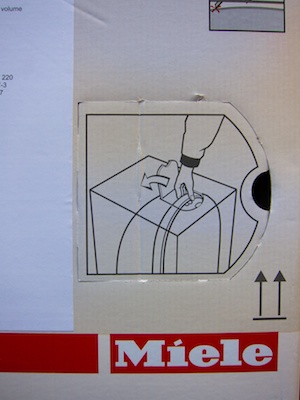
The lid on the side of the box is pre-cut on three of its four sides and bears a graphic that illustrates how to open it, and what to grab on the inside.

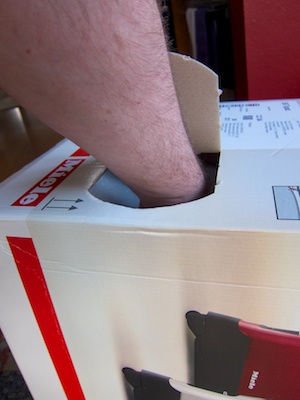
By reaching through the opened lid, you can get a solid grab on the vacuum’s handle, and carry the entire box and its contents around without too much hassle or effort.

By reaching through the opening, you can grab the handle of the vacuum that's inside the box.

Instant Airline Reward Miles Credit

Claiming missing airline reward miles was covered in four previous articles on this website now, but here’s a twist to that process that makes me revisit this topic one more time.

The first article in the series dates back to August 2010 and compared the workflows for claiming uncredited airline reward miles between Lufthansa’s Miles & More program and British Airways’ Executive Club.2

At the time, I did put in a claim for uncredited miles with Lufthansa, but did not have any similar request for British Airways. Thanks to my parents being on British Airways flights before signing up for BA’s loyalty program, I finally did get to test the entire process with an actual mileage claim.

Method A: “Type a lot, wait a couple of weeks, and then we’ll see what happens.”

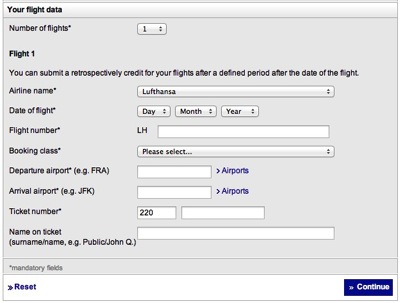
As a quick reminder, here’s the online form that Lufthansa requires you to fill out for claiming yet-uncredited reward miles:

The Miles & More reward miles claim form has eight fields for entering data like airline name, date of flight, etc. Of these eight fields, no less than seven are mandatory.

It is safe to assume that, like any other airline, Lufthansa keeps old booking records. With the ticket number serving as a unique identifier, why then are you required to fill in seven fields?

Method B: “Enter one number. Done!”

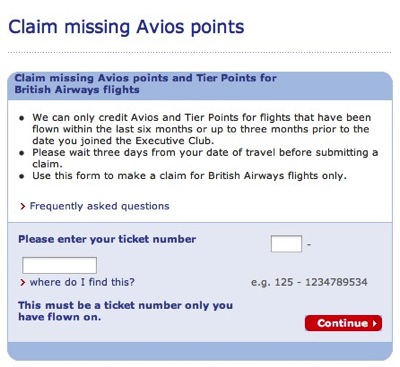
British Airways’ form requests that you enter exactly one data item which is, of course, the ticket number.

The British Airways form for claiming missing reward miles requires you to enter just the ticket number. Oddly though, this needs to be slit into two fields, one of which holds the first three digits, and the other holds the remaining ones.

When I tried this last time with a ticket number whose associated flights had already credited to my account, the website listed the respective flights’ miles as having been “[c]laimed previously through British Airways.”

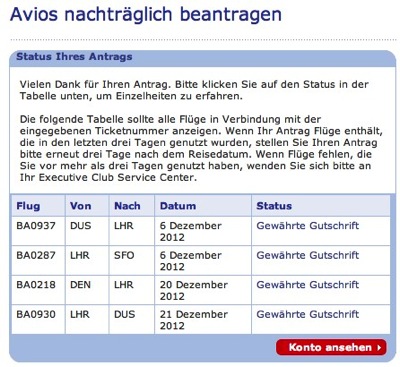
My parents’ newly created accounts had a mileage balance of exactly zero when I brought up the claim form this time. Entering a ticket number brought up a table of flights that was similar to the one I had seen previously.

After you enter the ticket number, and click Continue, the BA website will look up the flights that are linked to the number, and display them in a table.

The status, however, was now given as “Gewährte Gutschrift”: “Credit Granted”.

Clicking the “Konto ansehen” (“View Account”) button took me back to the account’s main page, and the balance now showed a non-zero amount.

Not only was it enough to enter just the ticket number; the respective reward miles were credited immediately without any wait time!

The possible impact of claiming miles from a partner airline

The mileage credit I had requested from Miles & More had been for a partner airline, and not for a flight with Lufthansa themselves. This may explain why it took a few weeks to see those miles added to my account.

It does not explain, however, why Lufthansa generally insists that you enter multiple redundant data items, whereas British Airways impressively demonstrates that this process works just fine if all you have is the ticket number.